FeNO in modern asthma care: diagnosis, monitoring and the pathway to biologics
FeNO in modern asthma care: diagnosis, monitoring and the pathway to biologics
FeNO brings airway inflammation into the consulting room. A quick, non-invasive breath measurement can strengthen an asthma diagnosis, identify a corticosteroid-responsive inflammatory pattern and help monitor treatment. In difficult-to-treat asthma, it also contributes to the type 2 assessment that informs consideration of biologic therapy. Dr Jason Edgar offers FeNO testing with the NObreath® device alongside specialist clinical assessment and full lung function testing.
Why FeNO deserves a place in modern asthma care
Spirometry describes airflow; FeNO adds information about the inflammatory process driving disease. Used together, they support a more individual approach: confirming a likely inflammatory airway disorder, reviewing response to a preventer and identifying patients whose ongoing disease deserves specialist phenotyping.
- Diagnosis: strengthens the evidence for type 2 asthma in a patient with a compatible history.
- Treatment planning: helps identify an inflammatory pattern more likely to respond to corticosteroids.
- Monitoring: adds an objective inflammatory measure to symptoms, exacerbations and lung function.
- Specialist referral: helps recognise persistent type 2 inflammation and informs assessment for targeted treatment.
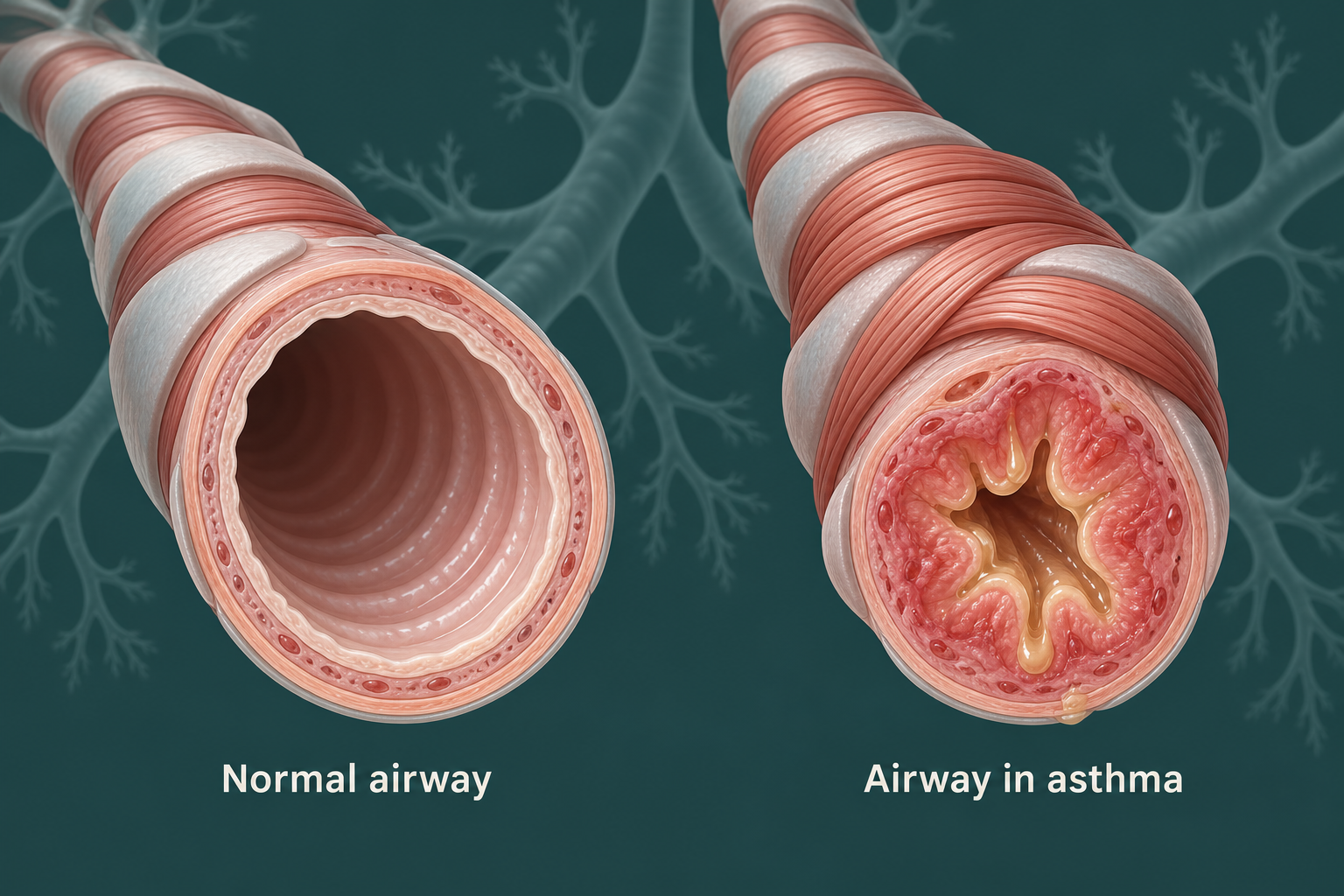
What are we measuring?
Fractional exhaled nitric oxide is reported in parts per billion at a standardised expiratory flow. It is a non-invasive marker associated with type 2 airway inflammation. It is neither a direct eosinophil count nor a measurement of obstruction. The clinically useful question is how this inflammatory information can strengthen diagnosis, guide treatment or clarify a response.
Its particular value is the additional information it provides alongside symptoms and physiological testing. This is reflected in guideline recommendations to incorporate FeNO into selected diagnostic and monitoring decisions. NAEPP/NHLBI 2020 focused updates: clinician guide.
Interpretation: separate inflammatory ranges from diagnostic thresholds
The ATS interpretive bands in adults are <25 ppb, 25–50 ppb and >50 ppb; the corresponding childhood bands are <20, 20–35 and >35 ppb. Low values make eosinophilic inflammation and corticosteroid responsiveness less likely; high values make them more likely in an appropriate symptomatic patient. Intermediate values require context. These are interpretive bands, not universal diagnostic criteria. ATS 2011 interpretation guideline.
By contrast, BTS/NICE/SIGN NG245 uses FeNO ≥50 ppb in adults with a suggestive history within its diagnostic pathway; the threshold for children aged 5–16 is ≥35 ppb. Further objective testing is required when initial testing does not confirm asthma. Inhaled corticosteroids can normalise test results. The difference between “>50” in an interpretive band and “≥50” in a diagnostic algorithm is intentional: use the threshold for the question and pathway being applied. BTS/NICE/SIGN NG245 recommendations, 2024.
Where does it fit in a primary-care work-up?
The ERS adult diagnostic guideline prioritises spirometry and bronchodilator reversibility, followed by FeNO when initial spirometry does not establish the diagnosis. Peak-flow variability and, where appropriate, bronchial challenge can help resolve remaining uncertainty. Normal spirometry between episodes does not settle the question. A raised FeNO result supports further diagnostic reasoning but is not synonymous with asthma: atopy, allergic rhinitis and eosinophilic bronchitis may also be relevant. ERS guideline for diagnosis of asthma in adults, 2022.
A practical referral question is more useful than an isolated request for a number: “Does this patient with variable wheeze and normal baseline spirometry have evidence supporting an inflammatory airway disorder?” Document symptom pattern, occupational or environmental triggers, previous objective tests, exacerbations and treatment exposure. This allows the result to be interpreted in the setting in which it was obtained.
What benefit does FeNO-guided care offer?
The ATS 2021 guideline makes a conditional recommendation for adding FeNO to usual care when asthma treatment is being considered, with low confidence in the estimates of effect. Its evidence synthesis supports potential reductions in exacerbations and oral corticosteroid use; improvements are not uniform across every outcome, and an individual result is not a dosing algorithm. This makes FeNO especially useful when there is a decision to make about anti-inflammatory treatment and future exacerbation risk. ATS 2021 clinical practice guideline; ATS summary for clinicians.
Using FeNO in someone already receiving treatment
GINA 2026 emphasises the importance of checking inhaler technique and adherence when FeNO remains high despite prescribed inhaled corticosteroids. Persistent elevation should prompt a review of actual treatment exposure, ongoing allergen exposure and the broader clinical picture before automatic escalation. A falling value after treatment can contribute to evidence that the inflammatory component is responding. Reviewing the trajectory alongside clinical outcomes makes follow-up more informative. GINA 2026 strategy and summary reports.
For serial measurements, record the clinical state and treatment at each visit. Comparing a symptomatic, untreated baseline with a clinically stable reading on treatment answers a different question from comparing two measurements obtained on the same regimen. Discuss changes alongside symptom burden, reliever use, exacerbations and lung function.
Measurement with NObreath
NObreath uses a controlled exhalation at 50 mL/s. The patient inhales away from the device, then exhales steadily through the mouthpiece while following its feedback. It is an exhale-only system; the patient must not inhale through the mouthpiece. Appropriate resistance helps limit nasal nitric oxide contamination. Coaching, an acceptable manoeuvre and documentation of testing conditions matter as much as the displayed number. Manufacturer's measurement guidance.
Getting the most from each measurement
- Was the patient already taking inhaled or systemic corticosteroids?
- Was there recent smoking, infection, unusual dietary intake or exercise that may have affected testing?
- Are atopy and upper-airway symptoms relevant?
- Was the manoeuvre technically satisfactory, and were the same measurement conditions used for comparison?
Recording these factors makes repeat measurements more clinically useful. Preparation and medication instructions should follow the testing service's protocol. Necessary treatment must not be delayed for an outpatient biomarker measurement. NHS FeNO patient information; NG245 rationale and impact.
Three illustrative primary-care scenarios
Variable wheeze, untreated, FeNO 68 ppb. This supports a type 2 inflammatory signal. Apply the chosen diagnostic pathway, review objective airflow assessment and consider competing explanations. The useful outcome is a documented diagnosis and treatment plan, rather than a “positive FeNO” label alone.
Persistent breathlessness on a preventer, FeNO 12 ppb. Do not infer that asthma has been excluded or stop the preventer on this basis. Review the original evidence for asthma, current physiology and other explanations for breathlessness; more corticosteroid is not automatically the answer either.
Repeated attacks and persistently high FeNO despite prescribed therapy. Review device technique, access to medication and actual use, then reassess ongoing exposures and comorbidity. Persistent difficulty after optimisation warrants specialist assessment rather than repeated empirical escalation.
These fictional examples illustrate synthesis of the guidelines above; they are not stand-alone prescribing rules.
FeNO and biologics: identifying a treatable type 2 signal
As targeted asthma treatments become an increasingly important part of specialist care, measuring inflammation helps connect an individual patient to a potentially relevant treatment pathway. FeNO and blood eosinophils capture complementary information; obtaining both can make the referral assessment more informative than either result in isolation.
Dupilumab (anti-IL-4 receptor alpha): a post-hoc analysis of the randomised LIBERTY ASTHMA QUEST trial found that baseline FeNO predicted treatment response independently of blood eosinophil count and other clinical characteristics. Higher FeNO identified patients with greater benefit. This supports measuring FeNO even when an eosinophil count is already available. Because this was a post-hoc analysis, it informs probability of response rather than guaranteeing an individual outcome. Pavord and colleagues: baseline FeNO and dupilumab response, 2023.
Tezepelumab (anti-TSLP): the NAVIGATOR randomised trial demonstrated fewer exacerbations and improvements in lung function and patient-reported outcomes in severe uncontrolled asthma. Its relevance extends beyond a single biomarker-defined subgroup. Menzies-Gow and colleagues: NAVIGATOR, 2021.
GINA 2026 identifies higher FeNO as a predictor of better response to dupilumab, tezepelumab and omalizumab. FeNO has a different role for anti-IL-5/IL-5R treatment, for which blood eosinophils are the more relevant established predictive biomarker. A low FeNO therefore does not exclude benefit from all biologic options. GINA 2026: biomarker applications in severe asthma.
For primary care, the actionable step is to recognise uncontrolled disease with a persistent inflammatory signal and refer for phenotyping. Specialist assessment combines the exacerbation history, treatment exposure, FeNO, eosinophils, allergic features and relevant comorbidity. Choice of treatment also depends on the medicine’s local indication, availability and funding criteria.
Monitoring in the era of targeted therapy
Record a baseline FeNO before a major treatment change where feasible, together with lung function, recent attacks, oral corticosteroid exposure and symptom burden. Follow-up then asks two linked questions: has the inflammatory signal changed, and has the patient improved? FeNO offers an objective measure to add to that discussion, particularly when symptoms and physiology appear discordant.
The response assessment should remain treatment-specific. A change in FeNO is not expected to have the same significance with every biologic. Clinically meaningful outcomes include fewer exacerbations, reduced oral corticosteroid exposure, improved function and better daily life. This is a practical application of the biomarker evidence above, rather than a universal FeNO target for continuing or switching a biologic.
A focused interpretation note
FeNO is valuable because it adds a different dimension to assessment. Low values do not exclude asthma, especially after corticosteroid treatment, and high values may also accompany other allergic or eosinophilic airway disorders. Interpret the measurement with the clinical history and lung function; do not withdraw ICS solely because FeNO is low.
When to consider pulmonology referral
- Diagnostic uncertainty, including discordance between symptoms, FeNO and spirometry.
- Recurrent exacerbations, repeated oral corticosteroid courses or persistent symptoms despite an optimised treatment plan.
- Possible occupational asthma or a competing respiratory diagnosis.
- Persistent type 2 inflammation with exacerbations or poor control despite optimised inhaled treatment, where biologic assessment may be appropriate.
- Need for more detailed physiological investigation or assessment of difficult-to-treat asthma and its inflammatory phenotype.
Referral can help answer whether the next step should be diagnostic testing, treatment optimisation or assessment for more advanced therapies. FeNO can be arranged alongside full lung function testing when clinically indicated. Acute severe deterioration requires urgent assessment rather than waiting for routine testing.
Refer to Dr Jason Edgar
Please phone 044 803 2497 or send an email referral to reception@dredgar.co.za. Referrals are screened to triage urgency and an appointment will be promptly arranged.
Clinical education for medical practitioners. Prepared September 2026 using the linked GINA, ATS, ERS, BTS/NICE/SIGN and NAEPP guidance. Apply clinical judgement and locally appropriate pathways to the individual patient.
Share this article
Know someone who might find this useful? Pass it on.
Respiratory education from Dr Jason Edgar
Pulmonologist & Specialist Physician · dredgar.co.za