Full lung function testing: a practical referral guide for GPs
CLINICAL REFERRAL GUIDE · 13 SEPTEMBER 2026
Full lung function testing: a practical referral guide for GPs
What spirometry, lung volumes and gas transfer add to assessment of breathlessness, and when a full physiological evaluation is useful.
What full testing adds
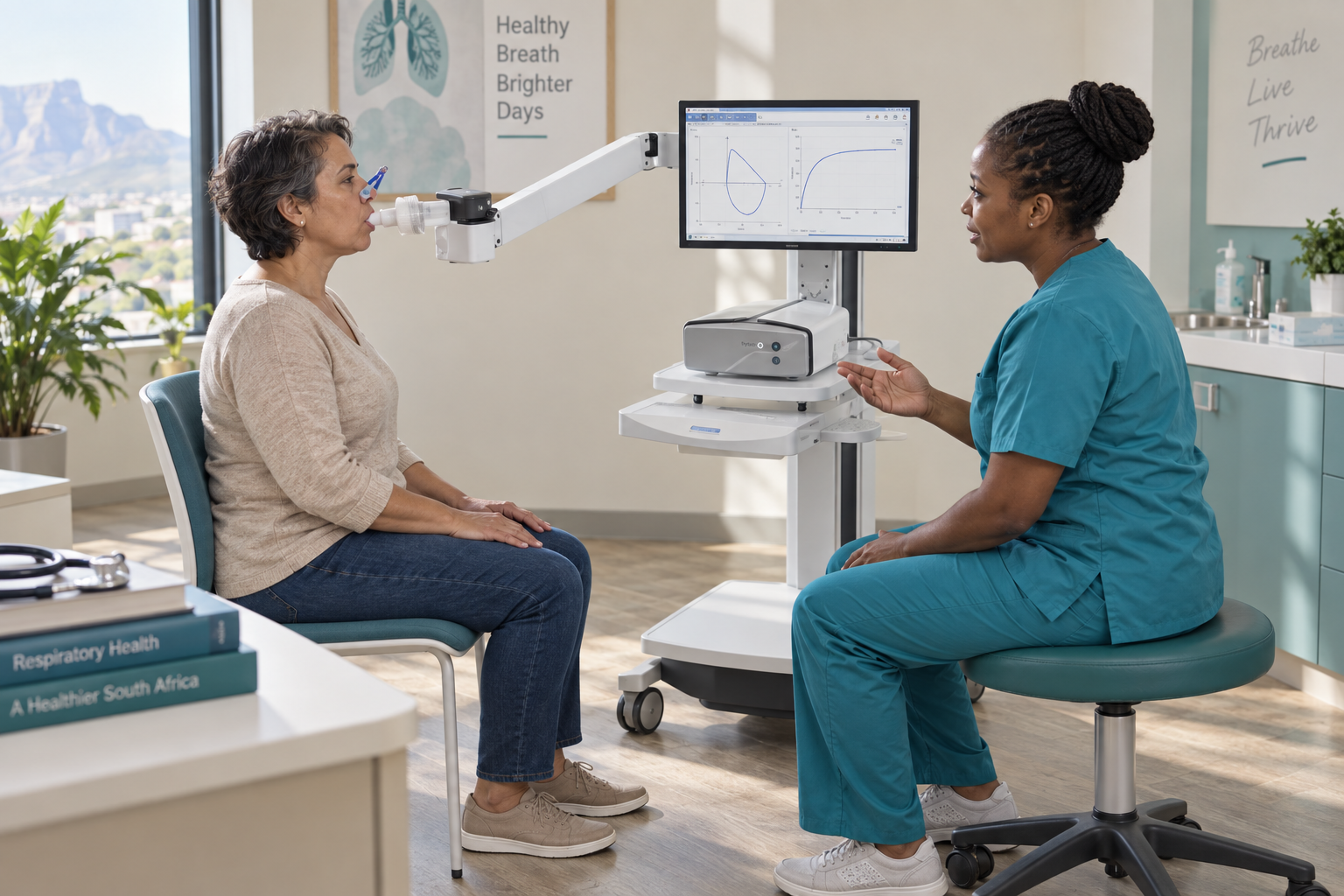
Full pulmonary function testing characterises airflow, lung volumes and gas transfer. It can explain abnormalities that office spirometry alone cannot resolve.
- Spirometry: assesses airflow and ventilatory pattern, with bronchodilator testing where indicated.
- Lung volumes, including plethysmography: measure total lung capacity and residual volume to assess restriction, air trapping and hyperinflation.
- Gas transfer (DLCO/TLCO): assesses transfer across the alveolar-capillary interface and adds information about parenchymal and pulmonary vascular disease.
A low FVC alone does not confirm restriction; a reduced total lung capacity is needed. A low DLCO is non-specific and should be interpreted with haemoglobin, test quality and the clinical picture. Normal spirometry does not exclude all respiratory disease. ERS/ATS interpretive standard, 2022.
Which patients may benefit?
- Patients with persistent unexplained breathlessness or symptoms disproportionate to initial spirometry.
- Patients with suspected restrictive disease, interstitial lung disease, emphysema or mixed ventilatory impairment.
- Patients requiring a baseline or interval assessment of known respiratory disease, or selected pre-operative evaluations.
Testing can also help assess suspected occupational effects and treatment response. Tests require cooperation and acceptable technique; results describe physiology rather than establish a diagnosis in isolation. ATS pulmonary function testing resource.
When to consider referral
Request full testing when initial results are abnormal, discordant or do not explain the symptoms. State the question clearly, for example: “Does the low FVC represent true restriction or air trapping?” or “Is gas transfer impaired despite preserved spirometry?” FeNO is a separate complementary assessment of airway inflammation, not a substitute for these measurements.
Helpful referral information
Include previous spirometry and trends, relevant imaging, symptoms, smoking and occupational history, inhaler treatment, oxygen use and a recent haemoglobin if available. Flag recent surgery, pneumothorax, cardiac events or acute respiratory infection so suitability and timing can be assessed. The laboratory should provide individual inhaler and preparation instructions.
Discuss a referral
Referrals are welcome by phone on 044 803 2497 or by email to reception@dredgar.co.za. All referrals are screened to triage urgency, and an appointment will be promptly arranged.
George consultations begin in November 2026. Milnerton consultations continue until the end of October 2026.
Educational information for healthcare professionals. Referral decisions and investigations should be individualised to the patient and local resources. Phone and email referrals do not replace emergency assessment.